Confimedis Platform v3.2.0
Overview
| Scope | Feature |
|---|---|
| Version | v3.2.0 |
| Release date | December 29, 2025 |
| Deployed to Confimedis Cloud | — |
| Affected modules | Randomization, Settings, Administration, Subjects |
Validation
Validation by Confimedis
Confimedis GmbH has validated this release in accordance with its quality management system and GAMP 5 before deployment, re-executing the test cases of the Operational Qualification (OQ) for the affected functions according to their risk classification. A release does not change the configuration of your study, such as forms, edit checks, roles, or users, which your Performance Qualification (PQ) covers. Where existing settings are migrated, the note says so. The Validation Package of every release, including the OQ report and a prefilled Validation Summary Report (VSR), is available on request and only needed for an initial validation or a revalidation. A test project is a copy of your study without patient data, created via CDISC ODM export and import.
This release predates the introduction of Release Impact Statements. Its changes are listed below.
Changes
Features
- Randomization: Randomization module
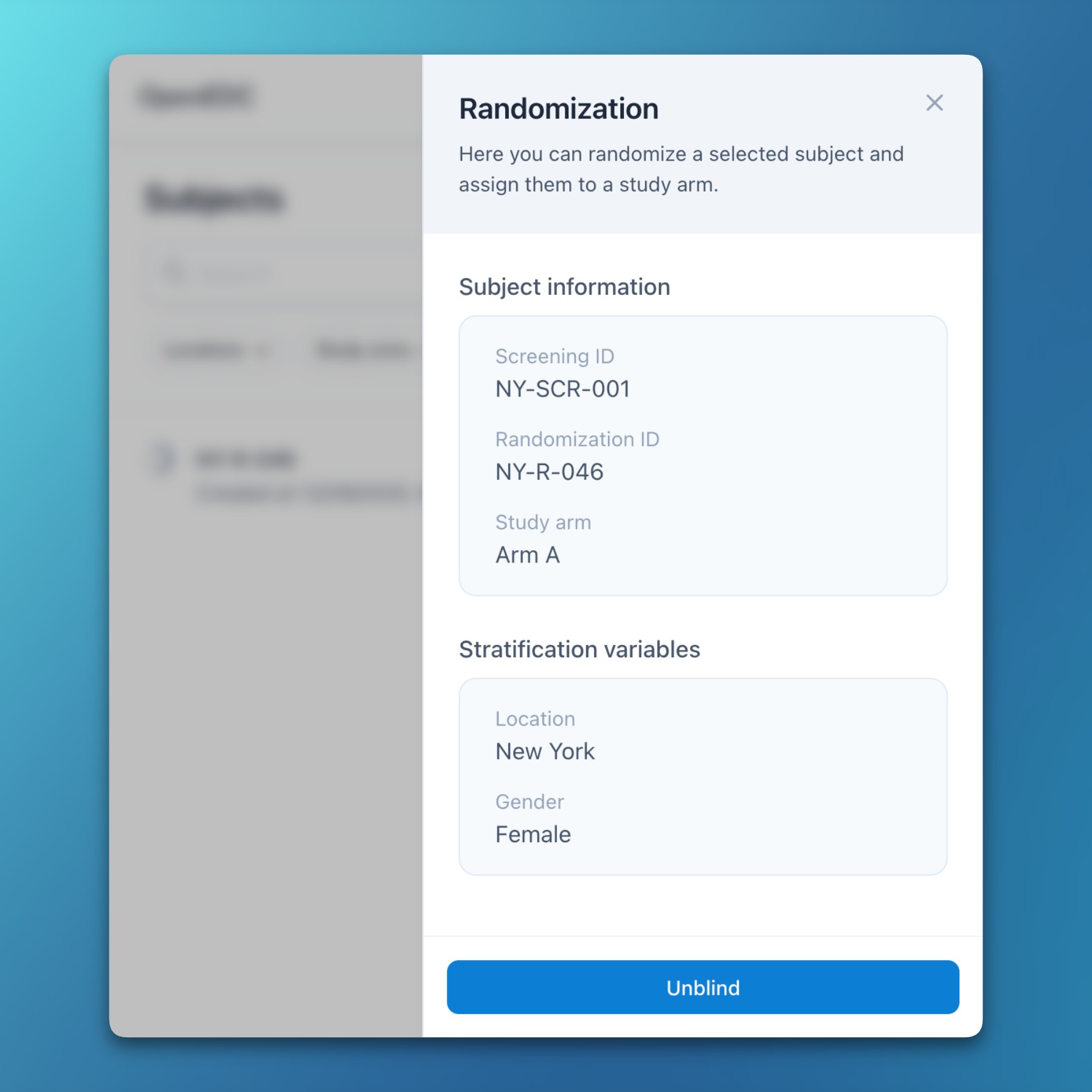
- Confimedis now includes an integrated randomization module with support for variable block sizes and stratification parameters.
- Enabling randomization is a guided four-step process: configuration, preview, review, and confirmation.
- Four additional permissions enable fine-grained control over configuration, review, randomization, and unblinding.
- Atomic database transactions ensure data integrity even when multiple users randomize subjects at the same time.
- After randomizing a subject, the screening ID remains visible in a dedicated information panel when needed.
- All randomization activities and configuration updates are logged in the audit trail.
- Settings: Subject key options
- To support flexible screening and randomization IDs, five new subject key options have been introduced:
- Minimum length: Ensures that subject keys are padded with zeros to a specified length (e.g., 001).
- Randomization/manual prefix: Adds a prefix before the randomized or manually entered key (e.g., R-001).
- Screening/auto-increment prefix: Adds a prefix before the screening or auto-incremented key (e.g., S-001).
- Location ID prefix: Adds the location ID before the key (e.g., NY-R-001 or NY-S-001).
- Location-scoped uniqueness: Requires subject IDs to be unique only within their location instead of globally across the study (e.g., allowing NY-R-001 and SF-R-001). This also applies to auto-incremented keys.
- These options can also be used for subject key customization without the randomization module.
- To support flexible screening and randomization IDs, five new subject key options have been introduced:
Improvements
- Administration: System administrators can now update their enterprise Confimedis instance semi-automatically via the administration module.
- Administration: System starts and updates are now recorded and visible for administrators in a new system audit log table.
Bug fixes
- Subjects: Solved an issue where auto-incremented subject keys were sometimes not displayed immediately when WebSocket connections were blocked by restrictive firewall settings (e.g., in enterprise environments).