Confimedis Plattform v3.2.0
Übersicht
| Umfang | Feature |
|---|---|
| Version | v3.2.0 |
| Veröffentlicht am | 29. Dezember 2025 |
| Bereitgestellt in der Confimedis Cloud | — |
| Betroffene Module | Randomization, Settings, Administration, Subjects |
Validierung
Validierung durch Confimedis
Die Confimedis GmbH hat diese Version vor der Bereitstellung gemäß ihrem Qualitätsmanagementsystem und GAMP 5 validiert und dabei die Testfälle der Operationalen Qualifizierung (OQ) für die betroffenen Funktionen entsprechend ihrer Risikoeinstufung erneut durchgeführt. Eine neue Version ändert die Konfiguration Ihrer Studie nicht, etwa Formulare, Prüfregeln, Rollen oder Nutzer, die Ihre Performance Qualifizierung (PQ) abdeckt. Werden bestehende Einstellungen migriert, nennt der Hinweis dies. Das Validierungspaket jeder Version mit OQ-Bericht und vorausgefülltem Validation Summary Report (VSR) erhalten Sie auf Anfrage, Sie benötigen es nur für eine Erstvalidierung oder eine Revalidierung. Ein Testprojekt ist eine Kopie Ihrer Studie ohne Patientendaten, die Sie per CDISC-ODM-Export und -Import anlegen.
Diese Version stammt aus der Zeit vor Einführung der Release Impact Statements. Ihre Änderungen sind unten aufgeführt.
Änderungen
Features
- Randomization: Randomization module
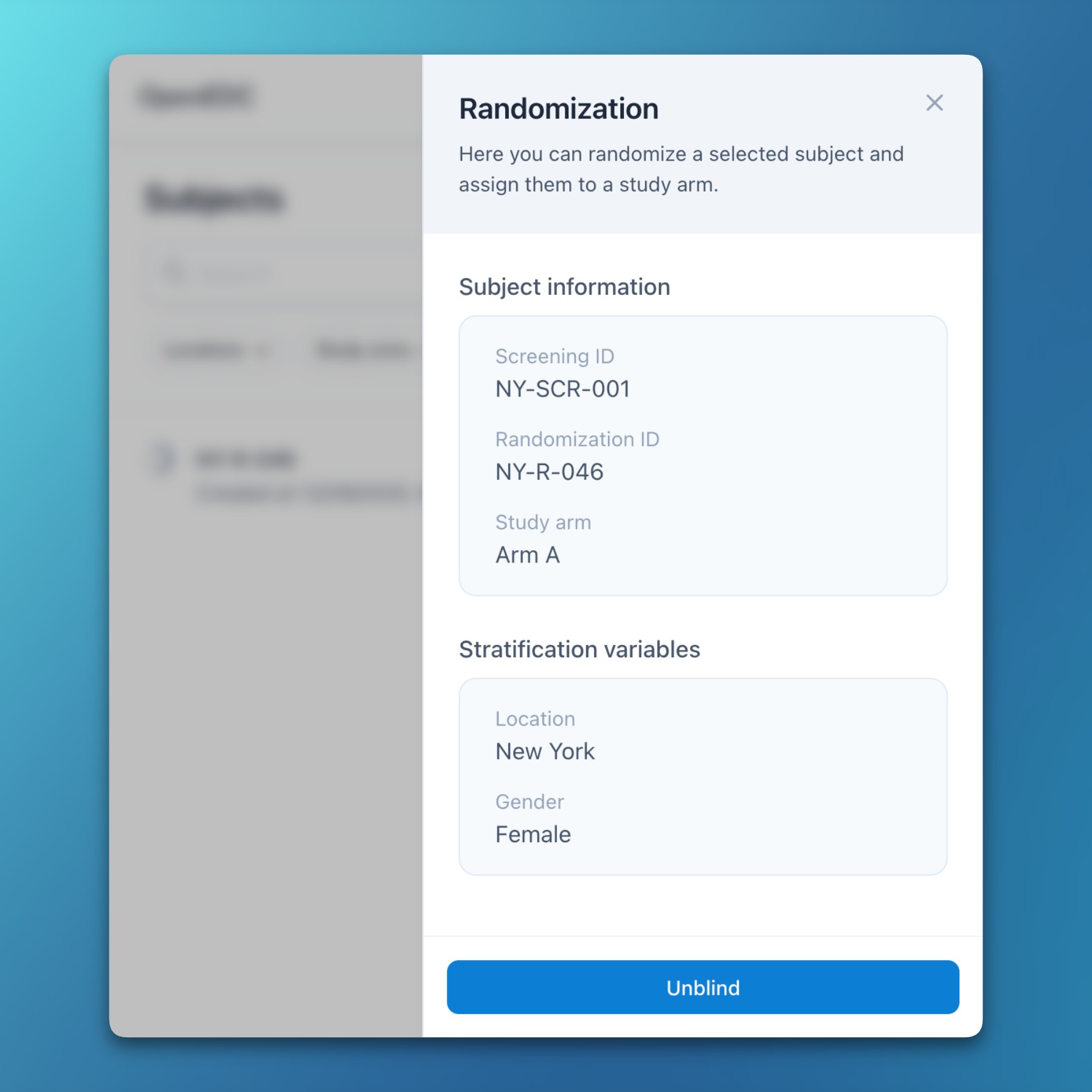
- Confimedis now includes an integrated randomization module with support for variable block sizes and stratification parameters.
- Enabling randomization is a guided four-step process: configuration, preview, review, and confirmation.
- Four additional permissions enable fine-grained control over configuration, review, randomization, and unblinding.
- Atomic database transactions ensure data integrity even when multiple users randomize subjects at the same time.
- After randomizing a subject, the screening ID remains visible in a dedicated information panel when needed.
- All randomization activities and configuration updates are logged in the audit trail.
- Settings: Subject key options
- To support flexible screening and randomization IDs, five new subject key options have been introduced:
- Minimum length: Ensures that subject keys are padded with zeros to a specified length (e.g., 001).
- Randomization/manual prefix: Adds a prefix before the randomized or manually entered key (e.g., R-001).
- Screening/auto-increment prefix: Adds a prefix before the screening or auto-incremented key (e.g., S-001).
- Location ID prefix: Adds the location ID before the key (e.g., NY-R-001 or NY-S-001).
- Location-scoped uniqueness: Requires subject IDs to be unique only within their location instead of globally across the study (e.g., allowing NY-R-001 and SF-R-001). This also applies to auto-incremented keys.
- These options can also be used for subject key customization without the randomization module.
- To support flexible screening and randomization IDs, five new subject key options have been introduced:
Improvements
- Administration: System administrators can now update their enterprise Confimedis instance semi-automatically via the administration module.
- Administration: System starts and updates are now recorded and visible for administrators in a new system audit log table.
Bug fixes
- Subjects: Solved an issue where auto-incremented subject keys were sometimes not displayed immediately when WebSocket connections were blocked by restrictive firewall settings (e.g., in enterprise environments).